01•Computer Vision•2026
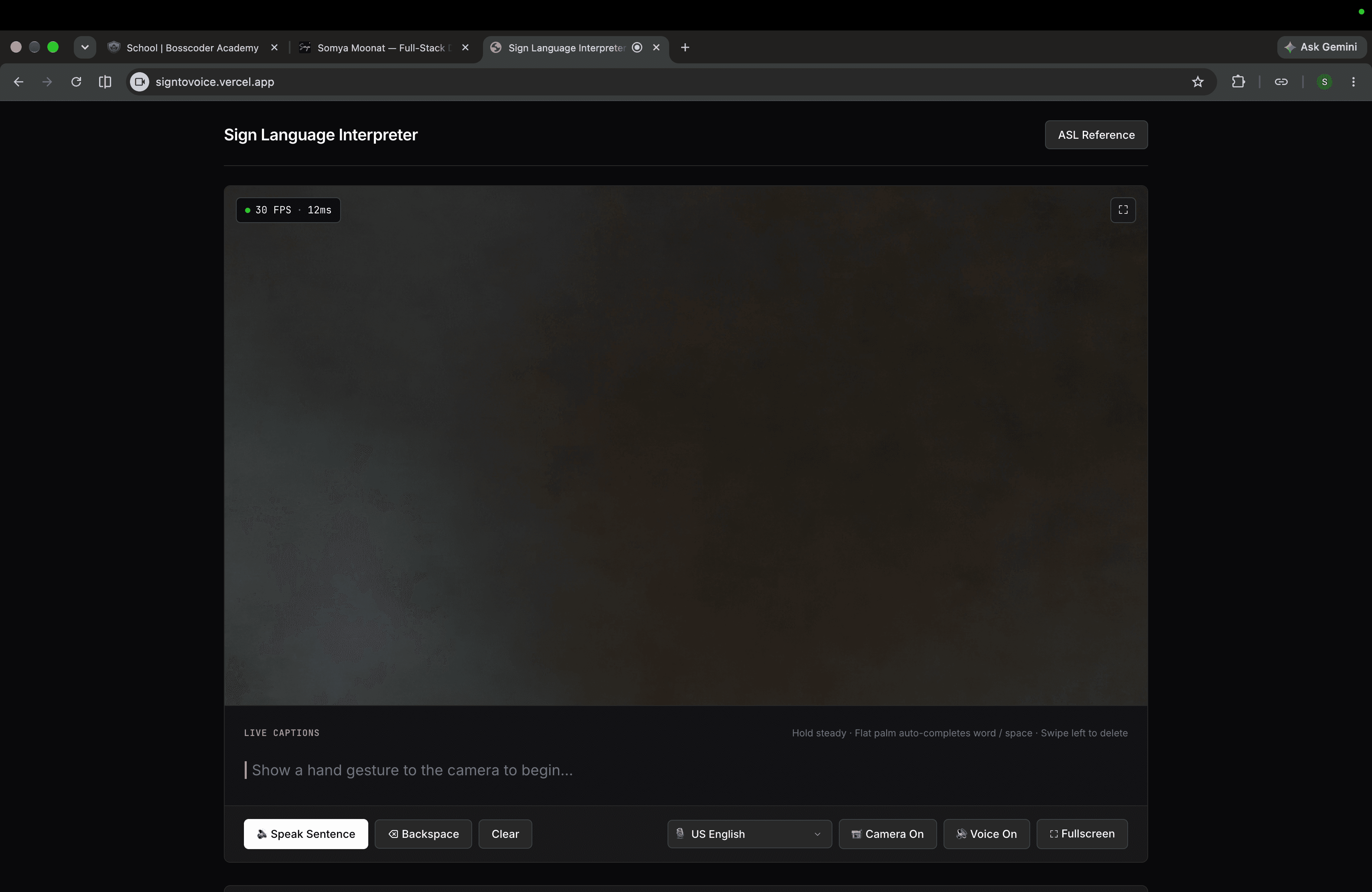
Sign Language Interpreter — Real-Time ASL to Voice Engine
→Real-time computer vision system translating ASL hand gestures into spoken voice on-device.
JavaScriptComputer VisionWebAssemblyWebGLSpeech SynthesisAccessibility
Full-stack web developer and machine learning engineer focused on practical software, clean architecture, and reliable systems.
Custom dataset curated with bounding box & semantic masks for object detection models.
Measured improvement in model validation precision by eliminating spatial label noise.
Deterministic alpha-beta game tree execution evaluated in pure client-side JavaScript.
Server-side headless PDF generation pipeline built with Python and WeasyPrint.
Selected production builds, distributed architectures, and machine learning implementations exploring concrete technical trade-offs.
Real-time computer vision system translating ASL hand gestures into spoken voice on-device.
Full-stack e-commerce store with NextAuth credentials, Prisma ORM, and Razorpay checkout.
Tactile incremental cleaning & automation mobile game built in Godot 4 / GDScript.
Interactive collaborative learning web platform with clean responsive architecture.
Browse all public repositories directly from @somyamoonat, updated whenever a new commit is pushed.
Real production logic extracts demonstrating client-side execution, offline-first reliability, and clean API boundaries.
Continuous webcam stream processed locally via WebAssembly hand landmark detector. Inferred gesture token maps to sign language vocabulary and dispatches utterance directly through the browser Web Speech Synthesis API without round-trip latency.
// Real-time ASL hand gesture inference loop on client hardware
export async function processVideoFrame(
  video: HTMLVideoElement,
  detector: HandLandmarker,
  synthesizer: SpeechSynthesis
): Promise<TranslationResult | null> {
  const timestamp = performance.now();
  const detection = await detector.detectForVideo(video, timestamp);

  if (!detection.landmarks || detection.landmarks.length === 0) {
    return null;
  }

  // 21 normalized 3D hand coordinates (x, y, z)
  const landmarks = detection.landmarks[0];
  const gestureToken = classifyGestureTopology(landmarks, {
    confidenceThreshold: 0.88,
    normalizeOrientation: true,
  });

  if (gestureToken && gestureToken !== previousToken) {
    // Zero cloud GPU streaming; instantaneous voice dispatch
    const utterance = new SpeechSynthesisUtterance(gestureToken.spokenText);
    utterance.rate = 1.05;
    synthesizer.speak(utterance);
    return { token: gestureToken.label, latencyMs: performance.now() - timestamp };
  }
  return null;
}I am an engineer focused on the intersection of modern web systems, computer vision, and applied machine learning. Most of my work involves Python and JavaScript, data labeling and preprocessing pipelines, OpenCV and NumPy workflows, and practical full-stack applications.
I value architectural clarity: reliable data pipelines, automated toolchains, defensive programming, and avoiding unnecessary abstractions that make software difficult to reason about.
Designing, building, and deploying client-side computer vision pipelines, full-stack Next.js applications, and automated document generation tools.
Curated, verified, and audited large-scale spatial computer vision datasets for object detection and boundary segmentation pipelines.
Built an interactive data exploration web tool and presented system architecture to evaluation panel.
Active problem solving focused on optimized time/space complexity, invariant design, and clean data structure implementations.
Arrays, Trees, Graphs, Two-Pointers, and Dynamic Programming.
Rated competitive rounds, mathematical logic, and graph theory.
Algorithmic contests, data structures, and edge-case verification.
Perspectives from project teammates, engineering mentors, and technical evaluators on engineering discipline and delivery.
Somya approaches machine learning with rare engineering discipline. His dataset auditing and meticulous bounding annotation resolved recurring false positives in our object detection tests, improving our baseline precision substantially.
Somya bridges deep mathematical algorithms with clean, responsive web software. Whether structuring Minimax game trees or architecting modular Python pipelines, his code is disciplined, defensive, and immediately readable.
Delivered end-to-end automation pipelines ahead of deadline. Somya communicates technical trade-offs with exceptional clarity, prioritizes architectural simplicity over bloat, and consistently meets production benchmarks.
Engineering essays, architectural breakdowns, and implementation notes on applied computer vision and full-stack software.
I’m always open to discussing full-stack engineering roles, machine learning research, interesting project ideas, or simply having a thoughtful technical conversation.
Leave your details and a short message. Responses are usually seen within 24 hours.